
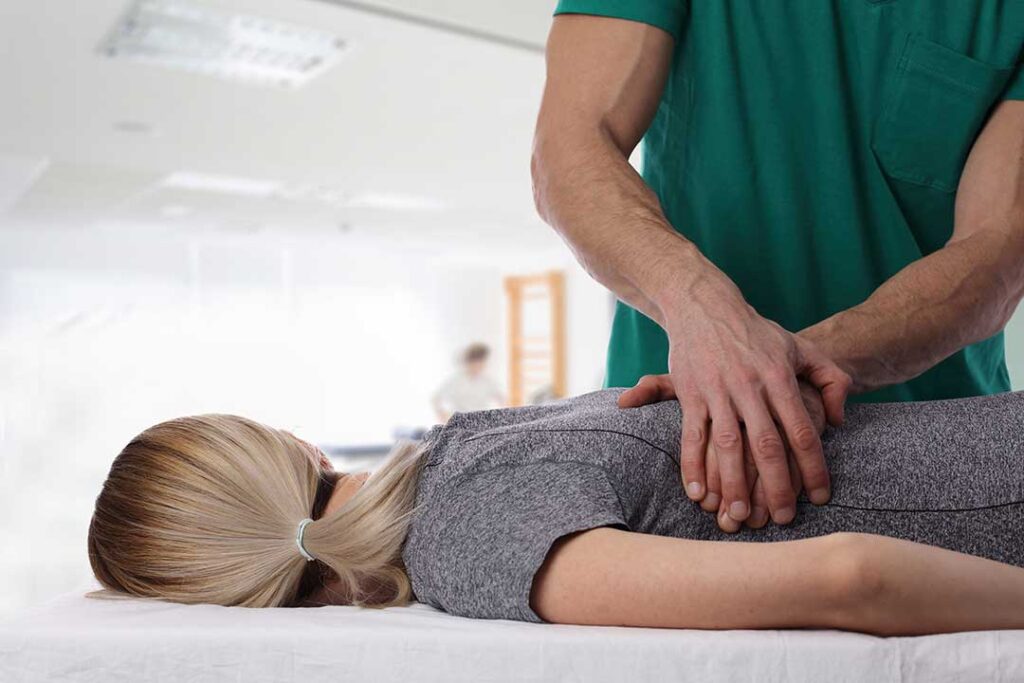
Scoliosis is a sideways curvature of the spine that may look like a mild shoulder or hip difference, or may cause ongoing pain and limited movement. Chiropractic care may help some people manage related discomfort and improve mobility, but current evidence does not show that chiropractic adjustments can reliably straighten a scoliosis curve or stop it from progressing.
What is scoliosis?
Scoliosis is a three-dimensional change in spinal shape. The spine may curve to one side and rotate slightly, which can make one shoulder blade, shoulder, waist, or hip appear higher than the other.
It is often identified during childhood or adolescence, sometimes before symptoms develop. Adults may also have scoliosis that began earlier in life or developed as a result of age-related changes, arthritis, osteoporosis, or spinal degeneration.
Common signs include:
- Uneven shoulders or hips
- A prominent shoulder blade
- Clothing that appears to hang unevenly
- One side of the rib cage appearing higher during a forward bend
- Back fatigue, stiffness, or pain
- Reduced tolerance for standing, walking, or household tasks
A posture difference does not automatically mean scoliosis. A physical examination and, when appropriate, standing X-rays are used to confirm the diagnosis and measure the curve.
Can chiropractic care correct scoliosis?
Chiropractic care should not be presented as a proven way to permanently correct a structural spinal curve. Adjustments may change joint motion, muscle tension, or pain levels for a period of time, but they have not been shown consistently to reverse scoliosis or prevent a curve from worsening.
That distinction matters. A person may feel looser or more comfortable after treatment without the underlying curve changing. Improvements in pain, flexibility, or daily function can still be meaningful, but they are different from correcting the scoliosis itself.
For residents in Lynbrook, seasonal routines may influence symptoms. Cold weather, reduced outdoor activity, prolonged sitting, and repeated lifting during home maintenance can increase stiffness or muscular discomfort. Those factors may aggravate symptoms without actually causing the spinal curve.
What may chiropractic care help with?
For some adults, conservative spinal care may be one part of a broader plan for managing pain or movement limitations. Depending on the individual, this may include gentle mobilization, soft-tissue techniques, stretching, ergonomic guidance, and exercises designed to improve strength and control.
Potential goals may include:
- Reducing muscle tension
- Improving comfortable spinal movement
- Supporting better tolerance for standing or walking
- Addressing stiffness after sitting
- Helping a person return gradually to ordinary activities
Care should be adapted to the type and severity of scoliosis, age, bone health, previous surgery, and the presence of nerve symptoms. Forceful or high-velocity techniques are not appropriate for every person, particularly those with osteoporosis, spinal instability, fractures, significant arthritis, or certain neurological conditions.
The most useful question is usually not, “Can an adjustment straighten my spine?” but rather, “Can this treatment safely help with a specific symptom or functional goal?”
What treatments are established for scoliosis?
Treatment depends on the size and location of the curve, the person’s age, whether the skeleton is still growing, symptoms, and the likelihood of progression.
For children and teenagers, common approaches include observation, bracing, and—in more severe or progressing cases—surgery. A brace is intended primarily to slow or prevent worsening while a young person is still growing. It is not the same as a chiropractic adjustment and should be managed through an appropriate medical evaluation.
Physical therapy may help improve muscle strength, posture, breathing mechanics, balance, and body awareness. Some scoliosis-specific exercise programs are designed to help a person actively control posture and movement. Evidence varies by program, but supervised exercise is generally considered more relevant to long-term function than passive treatment alone.

Adults often need symptom-based care rather than treatment aimed at changing the curve. Options may include exercise, physical therapy, medication, activity modification, injections, or surgery when symptoms are severe and other measures have not helped.
Should someone with scoliosis get an X-ray before treatment?
Not everyone with back pain needs imaging, but a known or suspected scoliosis may require an evaluation to determine whether the curve is structural, how large it is, and whether it has changed over time.
Imaging may be especially relevant when:
- The curve appears to be progressing
- Pain is new, severe, or unexplained
- Symptoms began after a fall or injury
- There is a history of osteoporosis or cancer
- Numbness, weakness, or changes in walking are present
- A child or teenager is growing rapidly
A treatment plan based only on visual posture or a brief examination may miss important information. Imaging decisions should be based on symptoms, age, examination findings, and clinical judgment rather than routine testing for everyone.
When is scoliosis more urgent?
Most scoliosis is not an emergency, but certain symptoms deserve prompt medical assessment. These include progressive weakness, numbness that spreads into an arm or leg, loss of coordination, difficulty controlling bladder or bowel function, unexplained fever, significant nighttime pain, sudden severe pain, or breathing difficulty.
A child or teenager with a visibly worsening curve should also be evaluated, particularly during a period of rapid growth. Early assessment can clarify whether observation, bracing, exercise, or another treatment is appropriate.
Adults with new or rapidly worsening curvature should be checked for conditions such as vertebral compression fractures, degenerative changes, or osteoporosis rather than assuming that symptoms are simply part of longstanding scoliosis.
How can daily habits support comfort?
Daily habits cannot reliably straighten scoliosis, but they may reduce strain and improve function. Helpful strategies often include changing position regularly, building back and abdominal strength gradually, using safe lifting mechanics, and maintaining general activity within comfortable limits.
For people who spend long periods at a desk, alternating sitting with brief walking or standing breaks may be more useful than trying to maintain a rigid posture all day. Household tasks can be divided into shorter sessions, especially during periods of stiffness or fatigue.
Sleep comfort also varies. A supportive mattress and a position that does not increase pain may help, but there is no single sleeping position that corrects scoliosis.
The most balanced view is that chiropractic care may have a role in symptom management for selected individuals, especially when combined with appropriate exercise and medical oversight. It should not replace evaluation, bracing when indicated, physical therapy, or surgical consultation when those treatments are medically appropriate.
