
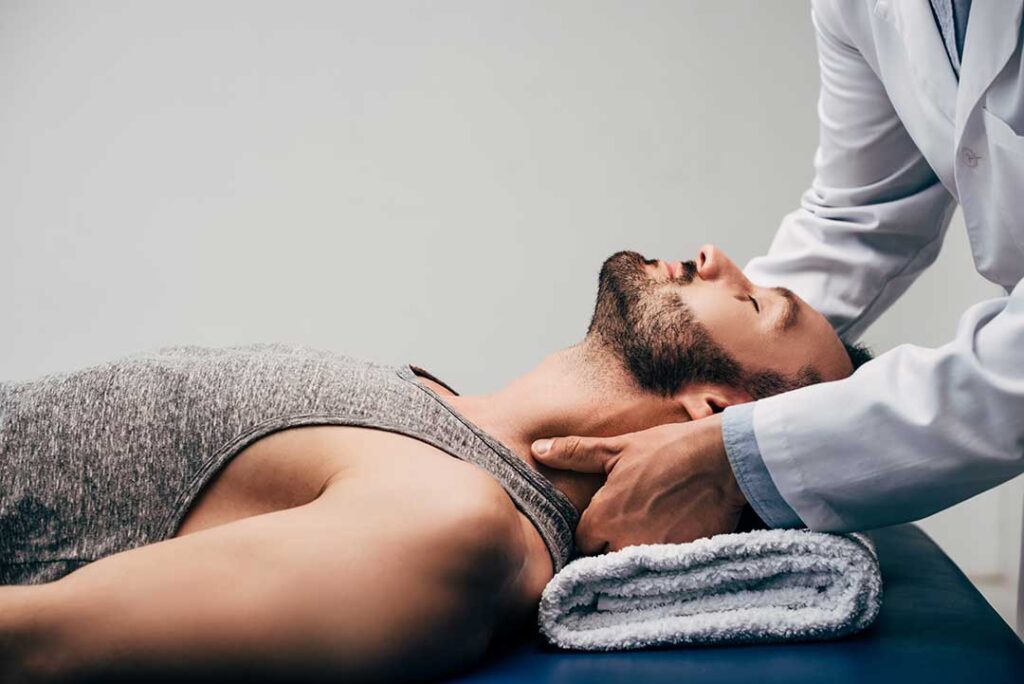
Clicking, popping, or crackling in the neck is common and often harmless, especially when it occurs without pain or other symptoms. The sound may come from normal joint movement, pressure changes inside small spinal joints, tendons shifting, or age-related changes in the neck.
The medical term for joint noises is crepitus. A clicking sound alone does not reveal the exact cause, so the most useful clues are when it happens, whether it is painful, and whether movement or nerve symptoms are also present.
Why does the neck click when it moves?
Most neck clicking comes from ordinary mechanical changes rather than damage. Small joints in the cervical spine can make noise as they glide during turning, looking up, or tilting the head.
Possible sources include:
- Pressure changes inside a joint: Movement can cause tiny gas pockets in joint fluid to shift or release, producing a pop.
- Tendons or ligaments moving: Soft tissues may briefly move over nearby bone and create a snapping or clicking sensation.
- Joint surface changes: Mild roughness from normal aging or osteoarthritis can produce crackling or grinding.
- Muscle tension: Tight neck and shoulder muscles can change how the joints move and make sounds more noticeable.
- Posture and repetitive activity: Long periods of looking down at a phone, working at a computer, driving, or reading can increase stiffness and make movement less smooth.
The sound may be more noticeable during colder months when people spend more time indoors, sit for longer periods, or layer clothing that limits comfortable shoulder and neck movement. These factors do not usually cause a serious neck condition by themselves, but they can make stiffness more apparent.
Is neck clicking without pain usually serious?
Neck clicking without pain, swelling, weakness, or loss of movement is usually not an emergency. Many healthy people notice occasional pops when turning their head or changing position.
A sound is less concerning when:
- It happens only occasionally.
- It does not follow an accident.
- There is no arm or hand numbness.
- Neck movement remains comfortable and reasonably normal.
- There are no headaches, dizziness, balance problems, or unusual weakness.
Clicking does not automatically mean that bones are rubbing together or that the spine is “out of place.” It also does not, by itself, prove that arthritis is present.
What conditions can make neck clicking more noticeable?
Several common conditions may contribute to clicking along with stiffness or discomfort.
Muscle strain can occur after sleeping in an awkward position, lifting, exercising, or spending hours with the head held forward. The muscles may tighten, changing the way the neck joints move.
Osteoarthritis may develop gradually as cartilage and other joint tissues change with age. It can cause stiffness, reduced motion, aching, and grating or crackling sounds. The presence of a sound alone does not confirm arthritis.
Disc or joint irritation can sometimes affect how the neck moves. If nearby nerves become irritated, symptoms may extend into the shoulder, arm, or hand.
Whiplash or another injury can strain muscles, ligaments, discs, or joints. Clicking after a collision, fall, sports injury, or sudden force deserves more attention than a long-standing painless pop.
Jaw clenching or teeth grinding may also contribute to tightness in the upper neck. Some people interpret a sound near the side of the face or below the ear as neck clicking when it is actually coming from the jaw joint.
Can poor posture cause the neck to click?
Poor posture may not directly create the sound, but it can increase stiffness and alter movement patterns. Holding the head forward while using a laptop or phone places greater demand on the muscles at the back of the neck and upper shoulders.
Helpful adjustments include:
- Keep screens near eye level rather than low in the lap.
- Change position regularly instead of staying still for long periods.
- Support the forearms during desk work.
- Avoid cradling a phone between the ear and shoulder.
- Use gentle, comfortable neck movement rather than forcing a stretch.

Residents in dense neighborhoods may spend substantial time commuting, working at desks, or using compact home workspaces. Small changes in screen height and seating can be more practical than trying to maintain a rigid “perfect posture” all day.
Is it safe to crack the neck on purpose?
Gentle, natural movement is generally different from forcefully twisting or pulling the neck to make it pop. Repeated or aggressive self-manipulation can strain muscles, irritate joints, or aggravate a nerve.
Avoid using sudden force, especially if the neck is painful, recently injured, unusually stiff, or associated with headaches, dizziness, or arm symptoms. A temporary feeling of relief does not necessarily mean that the underlying cause has been corrected.
If someone feels compelled to crack the neck every few minutes, or if cracking is followed by pain, the pattern deserves evaluation rather than more forceful stretching.
When should neck clicking be checked?
Medical evaluation is appropriate when clicking is accompanied by symptoms that suggest more than a harmless joint noise. Pay attention to:
- Persistent or worsening neck pain
- Significant stiffness or loss of motion
- Numbness, tingling, or weakness in an arm or hand
- Pain traveling from the neck into the shoulder or arm
- Recurrent headaches associated with neck movement
- Balance or coordination changes
- Clicking that began after a crash, fall, or other injury
- Fever, unexplained weight loss, or feeling unusually ill
Urgent care is warranted after an injury or when neck symptoms occur with marked weakness, loss of coordination, severe headache, dizziness, trouble walking, or loss of bladder or bowel control. Sudden neurological symptoms should be treated as an emergency.
What can help reduce harmless neck clicking?
The goal is not necessarily to eliminate every sound. It is to improve comfortable movement and reduce the conditions that make clicking frequent or irritating.
Try gentle range-of-motion movements within a comfortable limit, regular breaks from screens, adequate sleep support, and light activity that does not increase pain. Warmth may help muscle tightness, while avoiding the activity that clearly triggers symptoms can provide useful information.
Do not force a click, repeatedly test the neck, or continue an exercise that causes sharp pain, radiating symptoms, numbness, or weakness. Keeping track of when the sound occurs—such as after desk work, waking up, driving, or exercise—can help identify patterns.
A painless occasional click is often simply part of normal movement. Clicking that is new, painful, persistent, or paired with neurological symptoms should be judged by the complete symptom pattern rather than by the sound alone.
