
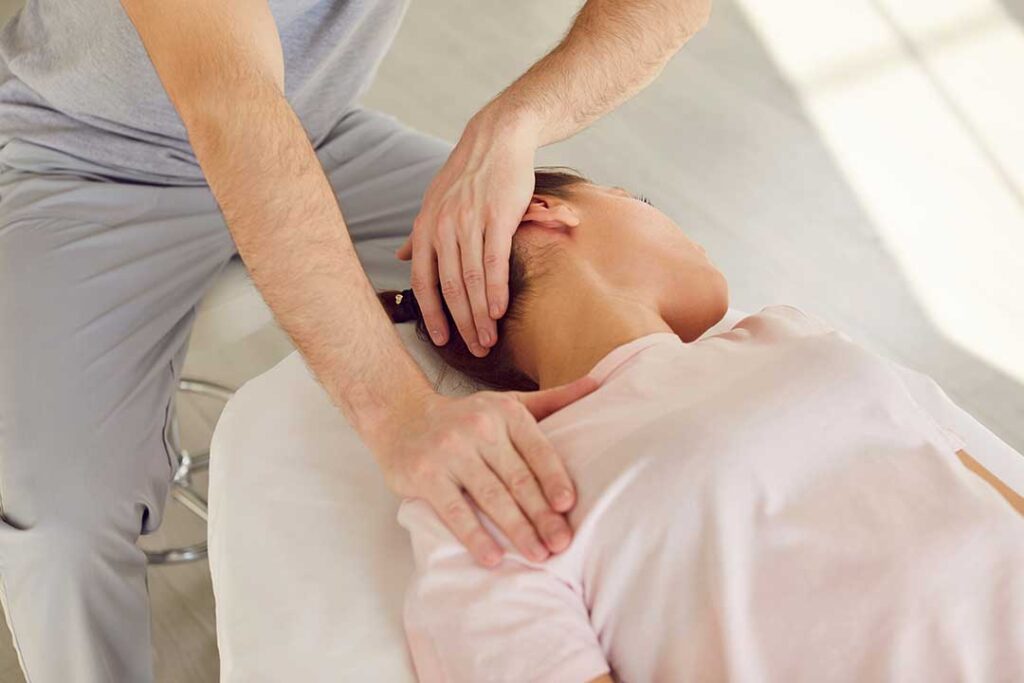
Tension headaches often feel like steady pressure, tightness, or a dull ache across the forehead, temples, scalp, or back of the head. Tight muscles in the neck, shoulders, upper back, and jaw can contribute, especially after long periods of screen use, driving, desk work, stress, or poor sleep.
Gentle stretching may reduce muscle tension and improve comfort for some people. Stretching should feel easy and controlled—not forceful, painful, or dizzying. These exercises are intended for common, mild tension-type symptoms and are not a substitute for evaluation of a new, severe, or unusual headache.
What does a tension headache usually feel like?
A tension headache commonly causes pressure or squeezing rather than throbbing. The discomfort may affect both sides of the head and may occur with tenderness in the scalp, neck, or shoulder muscles.
Common contributors include:
- Holding the head forward while using a phone or computer
- Clenching the teeth or tightening the jaw
- Carrying a heavy bag on one side
- Sleeping with the neck in an awkward position
- Stress, fatigue, dehydration, or skipped meals
- Remaining in one position for a long time
A headache that is strongly one-sided, pulsating, worsens with ordinary activity, or occurs with nausea or marked sensitivity to light may be more consistent with migraine than a typical tension headache.
Which stretches may help relieve neck and shoulder tension?
The most useful movements are usually gentle range-of-motion exercises that relax the muscles without forcing the neck into an extreme position. Move slowly, breathe normally, and stop if symptoms increase.
Chin tuck
Sit or stand with the shoulders relaxed. Look straight ahead and gently draw the chin backward, as though making a small “double chin.” Do not look down.
Hold for three to five seconds, then release. Repeat five to ten times.
This movement can help counter the forward-head position that often develops during computer work, phone use, or reading.
Upper trapezius stretch
Sit upright and allow the right arm to rest by your side. Gently tilt the left ear toward the left shoulder until a mild stretch is felt along the right side of the neck.
Hold for 15 to 20 seconds, then switch sides. Repeat two times per side.
Avoid pulling forcefully on the head. The stretch should remain comfortable and should not cause tingling, numbness, or sharp pain.
Levator scapulae stretch
Turn the head about 45 degrees to the right, then gently look downward toward the right armpit. A mild stretch may be felt along the back and side of the neck.
Hold for 15 to 20 seconds, then repeat on the other side. Perform one or two rounds.
This area can become tense when the shoulders remain raised or when the head is held forward for long periods.
Chest-opening stretch
Stand in a doorway with the forearms resting lightly against the frame and the elbows near shoulder height. Step forward slightly until a gentle stretch is felt across the chest.
Hold for 15 to 30 seconds while keeping the shoulders down. Repeat two or three times.
Opening the chest may make it easier to maintain a more neutral head and neck position, particularly after sitting at a desk.
Shoulder blade squeeze
Sit or stand with the arms relaxed. Gently draw the shoulder blades slightly down and back, as if placing them into opposite back pockets.
Hold for three to five seconds, then relax. Repeat eight to twelve times.
Do not shrug the shoulders or arch the lower back. This is a light activation exercise rather than a forceful strengthening movement.
Can jaw relaxation help a tension headache?
Yes. Jaw clenching can add tension around the temples, face, and neck. Many people clench without realizing it during concentration, driving, stressful conversations, or sleep.
Try this resting position:
- Place the tongue lightly on the roof of the mouth.
- Keep the lips gently together.
- Allow the teeth to remain slightly apart.
- Let the jaw muscles soften.
- Take five slow breaths.
A gentle massage of the temples or the muscles at the sides of the jaw may also feel soothing. Avoid deep pressure if the area is painful, swollen, or associated with clicking, locking, or difficulty opening the mouth.
How often should these stretches be performed?
For mild muscle-related tension, a short routine once or twice a day may be reasonable. It can also help to take movement breaks before discomfort becomes a headache.
During computer or household tasks, change position regularly. Every 30 to 60 minutes, stand up, roll the shoulders, look across the room, and take several relaxed breaths. Short, frequent breaks are generally more practical than waiting until the neck feels very stiff.
Local residents may spend more time indoors during cold, windy, or rainy weather. Indoor heating can also encourage prolonged sitting in one position. A brief mobility routine between remote work, household chores, studying, or evening screen use may help prevent tension from building.
What should be avoided during a headache?
Avoid bouncing, rapid neck circles, forceful stretching, or trying to “crack” the neck. Do not press into a stretch that causes sharp pain, dizziness, visual changes, weakness, numbness, or pain traveling into an arm.
Stretching should not be used to push through a severe headache. Rest, hydration, a quiet environment, and a comfortable neck position may be more appropriate while symptoms settle.
If a stretch repeatedly makes the headache worse, discontinue it. The cause may not be muscular, or the movement may not be suitable for the individual.
When should a headache be evaluated promptly?
Seek emergency care for a sudden, severe headache, especially if it reaches maximum intensity quickly. Immediate evaluation is also warranted when headache occurs with weakness, numbness, confusion, fainting, seizures, trouble speaking, double vision, fever, a stiff neck, or a recent head injury.
A medical evaluation is also appropriate when headaches are new, becoming more frequent, changing in pattern, interfering with daily activities, or requiring frequent use of pain medicine. Recurrent headaches should not automatically be attributed to posture or muscle tension.
Stretching can be a useful part of a broader routine, but identifying triggers matters too. Keeping a simple record of sleep, hydration, meals, screen time, jaw clenching, stress, and headache symptoms may reveal patterns that are easy to overlook.
