
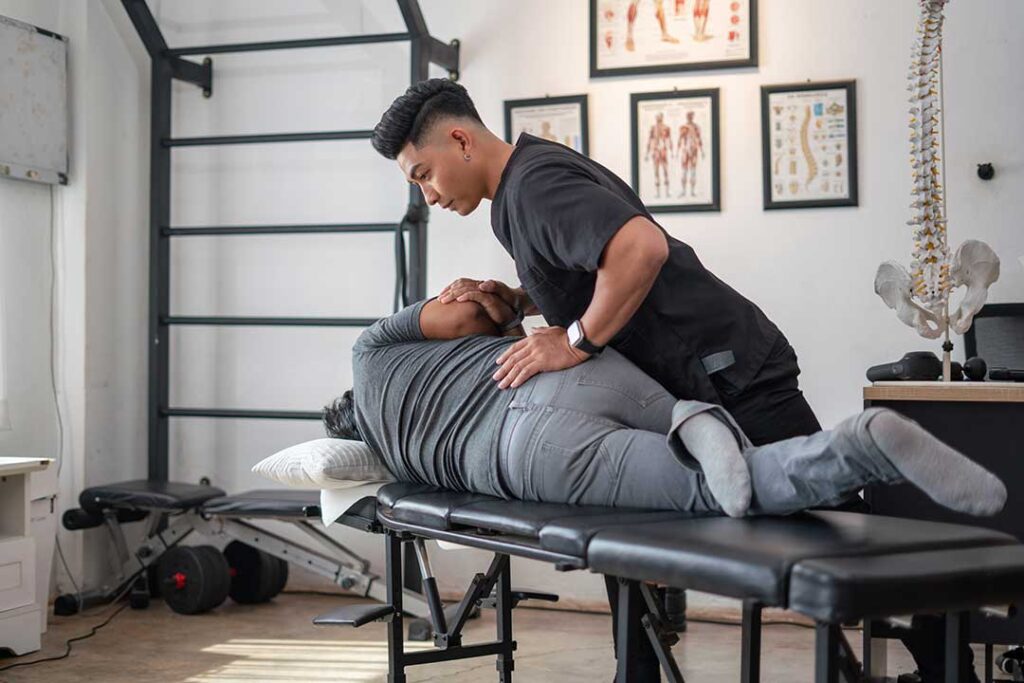
Jaw pain and spinal health can be connected through shared muscles, nerves, posture, and movement patterns. This does not mean that every jaw problem comes from the spine, but tension or restricted movement in the neck and upper back may contribute to symptoms around the jaw, face, temples, and ears.
Why can jaw pain be related to the neck and spine?
The jaw, neck, shoulders, and upper back work as part of a connected movement system. Muscles that help hold the head upright also influence the position and motion of the lower jaw. When the head moves forward for long periods, the neck muscles may work harder, while the jaw muscles remain tense.
This pattern can develop during:
- Extended computer or phone use
- Driving or commuting
- Reading with the head bent forward
- Sleeping in an awkward position
- Repetitive lifting or household tasks
- Stress-related clenching or teeth grinding
A stiff upper back or irritated neck does not directly “misalign” the jaw in every case. However, changes in posture and muscle activity can affect how the jaw opens and closes. Some people notice jaw discomfort along with neck tightness, headaches, shoulder tension, or pain near the base of the skull.
What is temporomandibular disorder?
Temporomandibular disorders, often called TMD, describe a group of conditions involving the jaw joints, chewing muscles, and nearby tissues. The temporomandibular joints are located just in front of the ears and act like hinges when the mouth opens and closes.
Possible symptoms include:
- Pain in the jaw joint or cheek muscles
- Tenderness near the temples or ears
- Jaw stiffness or limited opening
- Painful clicking, popping, or grinding
- A feeling that the jaw catches or locks
- Headaches that begin around the temples
- Pain spreading into the neck, face, or shoulders
- Changes in how the upper and lower teeth fit together
Jaw sounds without pain or restricted movement are common and may not require treatment. Pain, locking, or difficulty chewing deserves more attention than a sound by itself.
How does posture affect jaw symptoms?
Posture may influence jaw symptoms by changing the workload placed on the neck and chewing muscles. A forward head position can increase activity in some muscles beneath the jaw and along the front and sides of the neck. The body may respond by tightening nearby muscles to stabilize the head.
This is not a simple cause-and-effect relationship. Poor posture does not automatically create TMD, and correcting posture alone may not resolve jaw pain. Still, posture can be one contributing factor, particularly when symptoms increase after long periods of sitting.
A useful self-check is to notice whether the jaw is relaxed during routine activities. At rest, the teeth generally do not need to remain pressed together. The lips may be gently closed, while the tongue rests comfortably and the jaw muscles remain loose.
Can neck problems cause pain near the jaw or ear?
Yes, neck muscles and joints can refer pain to nearby areas, including the jaw, temple, cheek, and ear region. This means a person may feel pain in the jaw even when the main source is partly in the neck or upper back.
The reverse can also occur. Ongoing jaw muscle tension may cause the neck and shoulder muscles to work harder, leading to stiffness or headaches. Because these areas overlap, identifying the source requires attention to the full pattern:
- When the pain began
- Whether chewing or yawning increases it
- Whether neck movement changes the symptoms
- Whether there is tooth grinding or clenching
- Whether headaches, dizziness, or ear symptoms occur
- Whether there was an injury or recent dental procedure
Jaw pain is not always a spinal problem, and neck pain is not always caused by the jaw. Dental conditions, arthritis, injury, migraine, nerve irritation, and other health concerns can produce similar symptoms.
What can residents do at home?
Most mild, short-term jaw and neck symptoms can be approached with conservative measures. The goal is to reduce irritation without forcing the joint or repeatedly testing painful movements.
Helpful steps may include:
- Choosing softer foods temporarily if chewing is uncomfortable
- Avoiding gum, chewy foods, nail biting, and wide yawning
- Applying a warm compress to tense jaw or neck muscles
- Taking brief movement breaks during computer or phone use
- Adjusting the screen so the head does not remain angled downward
- Practicing slow, comfortable neck and shoulder movements
- Paying attention to daytime clenching, especially during stressful tasks
- Using pillows that keep the head and neck in a neutral position
In colder weather, some people unconsciously tighten the jaw, neck, and shoulders. Keeping the body warm and taking breaks from tense positions may help, but cold exposure is not usually the sole cause of a jaw disorder.
Exercises should remain gentle and should not produce sharp pain, locking, numbness, or worsening symptoms. Forceful jaw stretching or repeated attempts to make the joint click can aggravate irritated tissues.
What role can chiropractic care play?
A chiropractor may evaluate the neck, upper back, shoulders, posture, and movement patterns that could be contributing to muscle tension. Gentle manual techniques, mobility work, and exercise guidance may be considered when neck or upper-back factors are part of the problem.
Chiropractic care should not be treated as a universal solution for jaw disorders. The jaw joint, teeth, bite, chewing muscles, and medical history also matter. A coordinated evaluation may involve dental or medical care when symptoms suggest a tooth problem, significant joint disorder, nerve issue, or another condition outside the spine.
High-velocity manipulation directly involving the jaw is not appropriate for everyone. Any treatment should account for pain severity, joint stability, injury history, medications, and other health conditions.
When does jaw pain need prompt evaluation?
Prompt medical or dental evaluation is appropriate for severe or persistent pain, especially when the jaw locks, cannot open normally, or chewing becomes difficult. Evaluation is also important after a blow to the face or jaw, or when symptoms continue despite reasonable self-care.
Urgent attention is needed for jaw pain accompanied by chest pressure, shortness of breath, sweating, nausea, faintness, or pain spreading into the arm or upper body. These symptoms may signal a serious problem unrelated to the jaw joint.
Facial swelling, fever, difficulty swallowing, breathing problems, sudden weakness, or new numbness also require urgent assessment. A dental infection and several medical conditions can produce facial or jaw symptoms that should not be managed as a posture issue.
For local households balancing desk work, driving, caregiving, and seasonal outdoor tasks, the most useful approach is to view jaw pain as a whole-body symptom. The jaw and spine can influence one another, but accurate evaluation depends on the complete pattern rather than on posture alone.
