
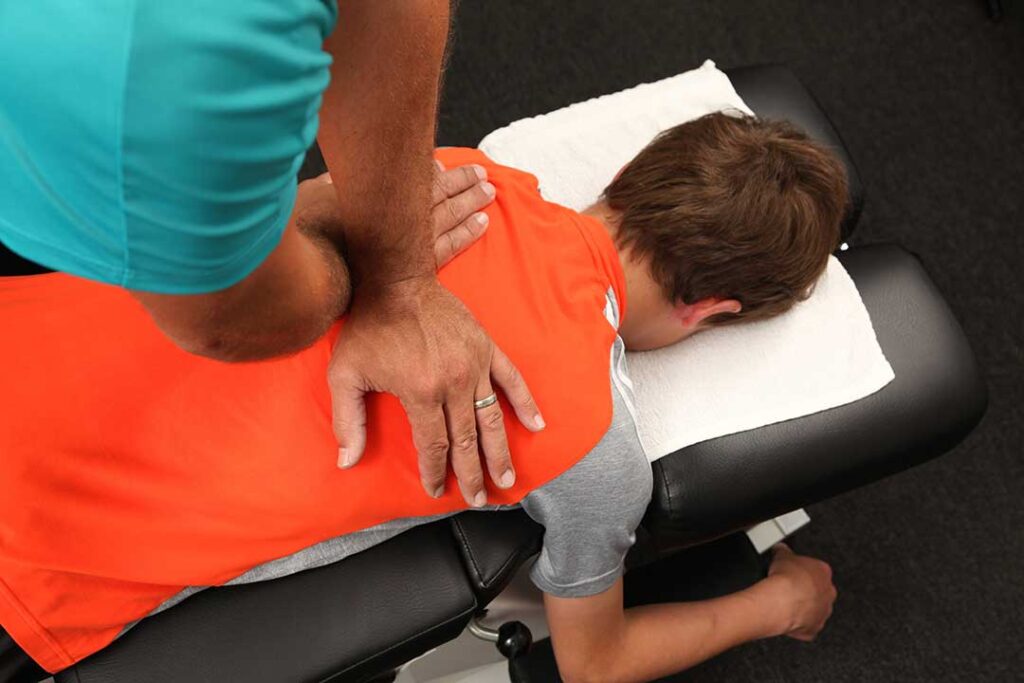
Spinal adjustments are hands-on techniques intended to influence movement in joints of the spine and surrounding tissues. They may reduce discomfort or improve mobility for some people, but the process is more complex than simply “putting a bone back into place.”
For residents of Lynbrook, NY, questions about spinal adjustments often arise after back or neck strain from commuting, home maintenance, prolonged sitting, recreational activity, or seasonal tasks such as shoveling. Understanding what research suggests—and what remains uncertain—can help people make informed health decisions.
What is a spinal adjustment?
A spinal adjustment is a manual technique in which a trained healthcare practitioner applies a controlled force to a spinal joint or related area. The force may be a quick, low-amplitude thrust, a slower mobilization, or another carefully directed movement.
The term “adjustment” is commonly used in chiropractic care, while “spinal manipulation” and “spinal mobilization” are often used in medical research. These terms do not always describe identical techniques.
An adjustment may be performed with the person lying on a padded table, seated, or positioned in another way. The technique selected depends on the area involved, symptoms, mobility, health history, and the practitioner’s assessment.
Does an adjustment move a bone back into place?
Usually, no. The common idea that a spinal adjustment permanently realigns a displaced vertebra is not well supported by current evidence.
Spinal joints naturally move within small ranges, and discomfort does not necessarily mean that a bone is out of position. Research has found that manipulation can sometimes produce short-term changes in joint spacing, spinal stiffness, or movement. However, studies have not established that routine adjustments permanently reposition vertebrae or correct a hidden spinal misalignment.
A more accurate explanation is that an adjustment may temporarily change how a joint, muscle, connective tissue, and nervous system respond to movement. Any improvement in pain or mobility may result from several effects occurring together rather than from a single bone being “put back.”
How might spinal adjustments reduce pain?
The strongest scientific explanations involve mechanical and nervous-system responses.
A spinal joint contains sensory receptors that detect pressure, movement, and changes in position. A controlled manual force can stimulate these receptors and alter signals traveling to the spinal cord and brain. This may influence how the nervous system processes pain in the short term.
Possible effects include:
- A temporary reduction in sensitivity to painful movement
- Improved tolerance for stretching or normal activity
- Changes in muscle activation around the treated area
- A modest increase in joint motion
- Reduced protective muscle guarding
Pain is not produced only by damaged tissue. It is also influenced by the nervous system, sleep, stress, prior injuries, physical conditioning, and expectations. Because of this, the same adjustment may feel helpful to one person and provide little benefit to another.
Some benefits may also come from non-specific factors, such as reassurance, attention, comfortable movement, and the natural variation of symptoms over time. These factors are part of many forms of healthcare and do not make a person’s improvement unreal.
What causes the popping sound?
The popping sound sometimes heard during an adjustment is called cavitation. It occurs when a joint is rapidly moved and pressure changes within the joint create a gas-filled space in the fluid.
The sound does not mean that a bone cracked, fractured, or moved dramatically. It also does not prove that the adjustment was effective. Some helpful adjustments produce no sound, and deliberately creating repeated popping is not necessary for treatment.
The sound may involve nitrogen and other gases already dissolved in joint fluid. After cavitation, the joint may not produce the same sound immediately because the gas requires time to return to solution.
Can spinal adjustments improve flexibility?
They may produce a short-term change in movement for some people, especially when pain or muscle guarding is limiting motion. Research has reported changes in range of motion and spinal stiffness after certain manual techniques, but these effects are not universal or necessarily long-lasting.
An adjustment should not be viewed as a substitute for strengthening, balance training, gradual activity, or changes in movement habits. For persistent problems, improvements are often better maintained when manual treatment—if appropriate—is combined with active exercises and normal daily movement.
For example, a person who develops low-back stiffness after sitting during a long commute may feel temporary relief after a manual technique. Building endurance in the hips and trunk, taking movement breaks, and gradually returning to activity may have a greater influence on long-term function.
Is spinal manipulation safe?

For many appropriately screened adults, spinal manipulation is associated with temporary side effects such as soreness, stiffness, fatigue, headache, or a short-lived increase in pain. These effects commonly resolve within a day or two.
Serious complications are uncommon, but they have been reported. Risk may be higher when a person has certain underlying conditions, recent trauma, severe osteoporosis, infection, cancer affecting the spine, significant neurological symptoms, or problems involving blood vessels in the neck.
A careful health history matters. Relevant information can include:
- Recent falls, crashes, or other injuries
- Numbness, weakness, or loss of coordination
- Unexplained fever or weight loss
- History of fractures or fragile bones
- Use of blood-thinning medication
- Recent surgery
- Known inflammatory, infectious, or neurological conditions
Sudden severe headache, fainting, confusion, difficulty speaking, new weakness, loss of bladder or bowel control, or rapidly worsening numbness requires urgent medical evaluation rather than routine manual treatment.
Are neck adjustments different from low-back adjustments?
Yes. The neck contains important nerves, joints, and blood vessels, and it has greater mobility than the lower back. Techniques applied to the cervical spine should therefore involve careful screening, clear explanation, and attention to alternatives.
Neck pain can also arise from conditions that require medical assessment, including significant injury, nerve compression, inflammatory disease, or problems unrelated to the spine. A person should not assume that every neck symptom is appropriate for manipulation.
What does the evidence actually show?
Evidence is strongest for modest, short-term benefits in some people with certain types of musculoskeletal pain, particularly uncomplicated low-back pain. Results vary, and spinal adjustments are not established treatments for every health condition.
Current research supports several possible mechanisms, including changes in pain sensitivity, muscle activity, joint movement, and spinal stiffness. However, scientists have not identified one universal mechanism that explains every response.
Claims that adjustments boost general immunity, cure internal diseases, permanently correct posture, or restore the body’s functions through a single spinal correction go beyond what current evidence can reliably support.
For local residents managing recurring back or neck discomfort, the most useful approach is usually a realistic one: identify warning signs, understand the likely source of symptoms, use movement-based care when suitable, and judge treatment by measurable changes in comfort and function rather than by the sound of an adjustment or the number of visits.
