
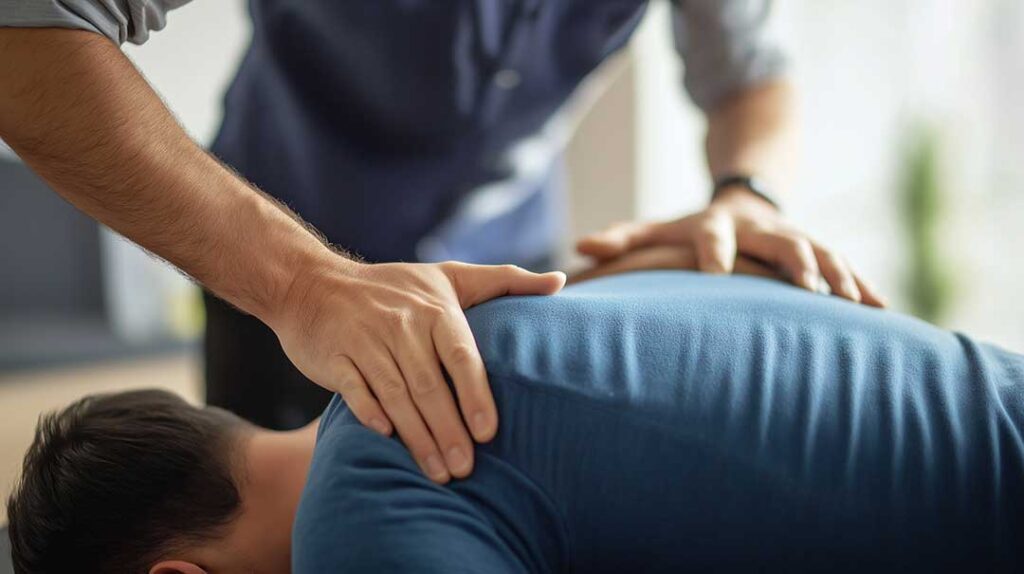
Scoliosis is a sideways curvature of the spine that may also involve rotation of the vertebrae. Chiropractic care may help some people manage related pain, stiffness, muscle tension, and movement limitations, but current evidence does not show that spinal adjustments can reliably straighten the curve or prevent scoliosis from progressing.
What is scoliosis?
Scoliosis is more than a temporary posture problem. The spine develops an abnormal side-to-side curve, sometimes forming a shape similar to a “C” or “S.” The condition can appear during childhood or adolescence, develop in adulthood, or result from another medical problem, injury, or age-related changes.
Common signs include:
- One shoulder or hip appearing higher than the other
- Uneven waistlines or clothing that hangs differently from one side
- A rib prominence when bending forward
- Back stiffness, fatigue, or pain
- Reduced tolerance for standing, walking, lifting, or household tasks
Many children and teenagers with mild scoliosis have no pain. In adults, symptoms may be related not only to the curve but also to arthritis, disc changes, muscle imbalance, spinal narrowing, or irritation of a nerve.
For families in Lynbrook, NY, scoliosis may become more noticeable during growth spurts or when children participate in school sports, dance, or other activities that make asymmetry easier to observe. Adults may notice symptoms after long periods of sitting, commuting, lifting, or working in a home environment that does not support comfortable posture.
Can chiropractic care correct scoliosis?
No reliable evidence shows that chiropractic adjustments can permanently correct a structural scoliosis curve. Adjustments may temporarily improve joint motion or reduce muscle guarding, but they should not be presented as a cure or as a replacement for medically appropriate scoliosis monitoring.
The established approach depends on factors such as:
- The size and location of the curve
- The person’s age and growth status
- Whether the curve is changing over time
- The presence of pain, weakness, breathing problems, or nerve symptoms
- Whether another condition caused the curvature
Mild curves may only require observation. Growing children with a moderate curve may be considered for bracing. More severe or progressive cases may require evaluation by a spine specialist, and some people may eventually be offered surgery.
Chiropractic treatment should therefore be viewed, at most, as supportive care for selected symptoms rather than a method of reshaping the spine.
What symptoms might chiropractic care help?
Some people with scoliosis experience discomfort from uneven loading of the muscles and joints around the spine. Gentle, individualized care may help with short-term symptoms such as:
- Muscle tightness or spasms
- Reduced spinal or hip mobility
- Mechanical back pain
- Stiffness after sitting or standing
- Difficulty moving comfortably during everyday activities
Potential care may include movement advice, mobility exercises, soft-tissue techniques, and carefully selected manual treatment. The goal is symptom management and improved function, not forcing the spine into a normal shape.
Responses vary. A person with mild adult scoliosis and muscular back pain may experience useful relief, while someone with worsening curvature, nerve compression, or significant structural changes may need a different treatment plan.
Is chiropractic care safe for children and teenagers with scoliosis?
Children and teenagers should not receive treatment for scoliosis based only on a visual posture check. A proper evaluation may require a medical history, physical examination, and imaging to measure the curve and determine whether it is changing.
For a growing child, the most important issue is identifying progression early. Manual treatment should not delay recommended observation, bracing, physical therapy, or specialist assessment. Any technique used should be age-appropriate, gentle, and adapted to the child’s diagnosis and symptoms.
Parents should be cautious of claims that a series of adjustments will eliminate the curve, prevent all future progression, or make X-ray monitoring unnecessary. Those claims go beyond the available evidence.
How is scoliosis usually evaluated?
A healthcare evaluation generally begins with questions about symptoms, family history, growth, injuries, and changes in posture. The examiner may check shoulder and hip height, spinal movement, balance, leg strength, reflexes, and sensation.
X-rays are commonly used to confirm scoliosis and measure the curve. A measurement known as the Cobb angle helps describe severity, although treatment decisions do not depend on that number alone.
Additional testing may be considered when symptoms suggest another problem. For example, persistent leg weakness, numbness, bowel or bladder changes, unusual night pain, or a rapid change in symptoms may require prompt medical assessment.
A posture photograph or home screening can raise a question, but it cannot diagnose scoliosis or determine whether a curve is progressing.
What treatments may be combined with symptom-focused care?
Treatment is individualized. Depending on age and severity, care may include observation, bracing, exercise-based physical therapy, pain management, activity modification, or surgery.
Physical therapy may focus on:
- Strengthening the trunk, hips, and upper back
- Improving balance and body awareness
- Building endurance for standing and walking
- Practicing scoliosis-specific positioning or breathing exercises
- Making daily movements more efficient

Exercise usually supports strength, mobility, and confidence. It should not be described as a guaranteed way to reverse a structural curve. Staying active is generally helpful, but activities may need modification if they consistently increase pain or cause neurological symptoms.
For adults, treatment may also address arthritis, disc degeneration, osteoporosis, or spinal stenosis. These conditions can exist alongside scoliosis and may be the main reason for pain.
When should someone seek prompt medical attention?
Back discomfort associated with scoliosis is often manageable, but certain symptoms should not be treated as ordinary muscle tension. Prompt medical evaluation is appropriate for:
- New or worsening weakness in an arm or leg
- Numbness that spreads or does not improve
- Loss of balance or repeated falls
- Loss of bowel or bladder control
- Severe pain after a fall or other injury
- Fever, unexplained weight loss, or significant night pain
- Rapidly increasing spinal deformity
- Shortness of breath associated with a severe curve
These symptoms may point to nerve compression, infection, fracture, or another condition requiring medical investigation.
What should residents ask before trying chiropractic treatment?
Useful questions include:
- Is the suspected curve confirmed, or is this only a posture observation?
- Has the curve been measured and monitored over time?
- What specific symptom is the treatment intended to address?
- Could the treatment interfere with bracing, physical therapy, or another plan?
- What signs would mean treatment should stop?
- How will progress be measured besides temporary pain relief?
A clear answer should distinguish between improving comfort and changing the underlying spinal curve. For people with diagnosed scoliosis, coordinated care is especially important if symptoms are worsening or the person is still growing.
For local households, practical factors also matter. Winter shoveling, slippery sidewalks, prolonged sitting during school or work, and lifting in compact home spaces can aggravate back symptoms without necessarily changing the scoliosis itself. Learning safer movement patterns and maintaining general strength may reduce strain while the underlying condition is monitored.
The practical answer
Chiropractic care may provide short-term relief for selected symptoms related to scoliosis, such as stiffness, muscle tension, or mechanical back pain. It has not been shown to reliably correct the spinal curve or replace established treatments such as observation, bracing, physical therapy, or medically indicated surgery.
The safest approach is to treat scoliosis as a structural condition that deserves appropriate evaluation, while using symptom-focused care only as part of a broader, individualized plan.
