
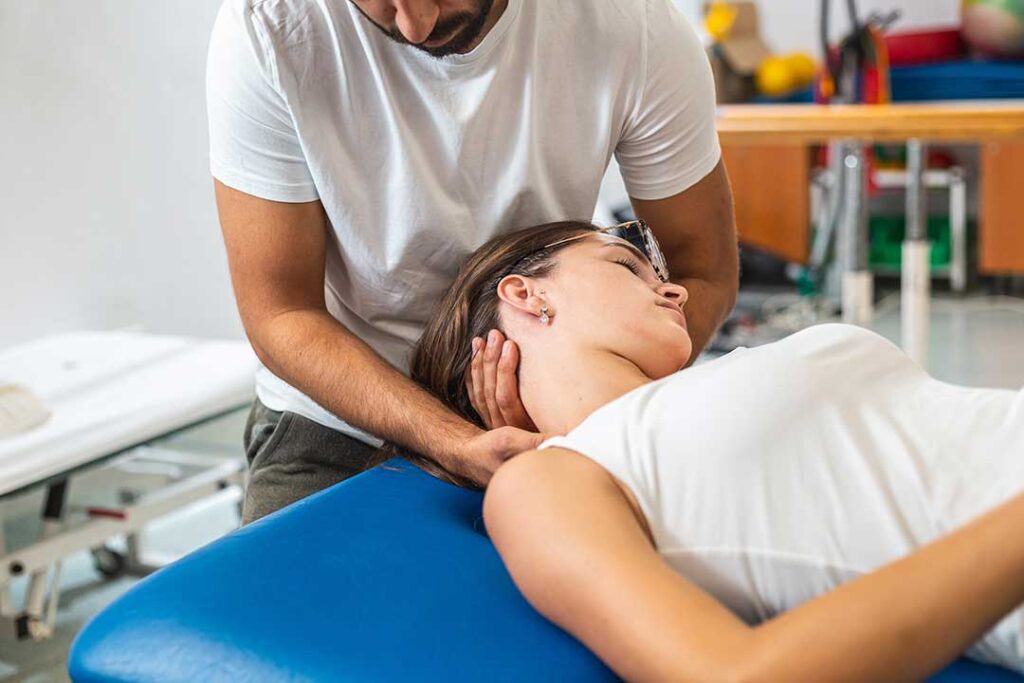
Scoliosis is a three-dimensional change in the shape of the spine that can cause a sideways curve and rotation of the vertebrae. Chiropractic care may help some people manage related pain, stiffness, or movement limitations, but current evidence does not show that spinal adjustments reliably straighten a scoliosis curve or prevent it from progressing.
What is scoliosis?
Scoliosis is generally identified when the spine has a measurable curve of at least 10 degrees, along with rotation of the spine. It most often develops during childhood or adolescence, although adults may develop or experience worsening curvature because of age-related spinal changes, arthritis, osteoporosis, or an earlier untreated curve.
A visible uneven shoulder, prominent shoulder blade, uneven waist, or one hip sitting higher than the other can be a reason to seek an evaluation. Some people have no obvious signs. Others notice back fatigue, muscle tightness, reduced tolerance for standing, or pain after household work, commuting, exercise, or prolonged sitting.
The size and location of the curve matter. So do age, growth status, symptoms, balance, nerve findings, and whether the curve is changing over time. A posture check alone cannot determine the severity of scoliosis; imaging and clinical assessment may be needed.
Can chiropractic care correct scoliosis?
Not reliably. Research on chiropractic manipulation for scoliosis remains limited, and systematic reviews have found small studies, weak controls, and insufficient evidence to determine whether spinal manipulation changes the underlying curve. A recent review found that high-velocity spinal manipulation did not significantly reduce spinal deformity or improve quality of life, although it may help reduce pain in some patients. ([pubmed.ncbi.nlm.nih.gov](https://pubmed.ncbi.nlm.nih.gov/28822477/?utm_source=openai))
This distinction is important:
- Curve correction: Changing the measured scoliosis curve or stopping progression.
- Symptom management: Reducing pain, muscle tension, stiffness, or difficulty with movement.
Chiropractic treatment may sometimes be used as part of symptom management, particularly when discomfort is related to muscle guarding, restricted movement, or another mechanical source. That does not mean the treatment has corrected the scoliosis itself.
For adolescents with idiopathic scoliosis, the available evidence is not strong enough to recommend spinal manipulation as a replacement for established monitoring, bracing when indicated, or scoliosis-specific rehabilitation. ([pmc.ncbi.nlm.nih.gov](https://pmc.ncbi.nlm.nih.gov/articles/PMC3675366/?utm_source=openai))
What might chiropractic care help with?
A carefully planned treatment approach may focus on comfort and function rather than promising to reshape the spine. Depending on the individual, this can include gentle manual techniques, mobility work, soft-tissue treatment, ergonomic guidance, and exercises designed to improve strength or movement tolerance.
Possible goals include:
- Reducing muscular tightness around the spine, hips, or shoulders
- Improving tolerance for standing, walking, or sitting
- Addressing pain that is separate from the curve itself
- Supporting general mobility and coordination
- Identifying activities or positions that repeatedly aggravate symptoms
For a resident managing winter stiffness, shoveling, carrying groceries, or long periods of sitting at a desk, practical movement changes may be as relevant as hands-on treatment. Pacing, alternating positions, using safe lifting mechanics, and maintaining regular physical activity can help prevent deconditioning.
Any exercise plan should account for the curve pattern, pain level, age, strength, balance, and other health conditions. A generic “spine straightening” routine is not appropriate for everyone.
When is medical evaluation more important than manipulation?
Scoliosis should not be treated as a routine joint-alignment problem when warning signs are present. Prompt medical assessment is especially appropriate for:
- New or rapidly worsening pain
- Numbness, weakness, or tingling in an arm or leg
- Changes in walking, balance, or coordination
- Loss of bladder or bowel control
- Fever, unexplained weight loss, or severe nighttime pain
- A recent fall or other significant injury
- Breathing difficulty associated with a large curve
- A child or teenager who appears to be progressing during growth

In children and adolescents, the timing of growth can affect treatment decisions. A curve that is mild and stable may only require observation, while a curve that is progressing may require specialist monitoring or bracing. Larger or worsening curves may need orthopedic evaluation. The American Academy of Orthopaedic Surgeons notes that some curves need no treatment, while severe untreated curves can affect the chest and breathing. ([orthoinfo.aaos.org](https://orthoinfo.aaos.org/globalassets/pdfs/scoliosis-in-children.pdf?utm_source=openai))
How should chiropractic care fit with other treatment?
Chiropractic care, if considered, should complement—not replace—appropriate scoliosis evaluation. Useful coordination may involve a primary care clinician, orthopedic specialist, physical therapist, or other qualified clinician familiar with spinal deformity.
A reasonable plan should clearly identify:
- The type and estimated severity of the curve
- Whether imaging has been performed or is needed
- The main goal of treatment, such as pain relief or improved function
- How progress will be measured
- When treatment should be changed or stopped
- Whether referral is needed because of age, curve progression, or neurological symptoms
Repeated claims that adjustments can “put the spine back in place,” permanently eliminate scoliosis, or prevent all future progression are not supported by strong evidence. The Scoliosis Research Society identifies bracing and surgery as treatments with established effects on certain idiopathic scoliosis curves, while evidence for chiropractic care affecting the curve remains lacking. ([srs.org](https://www.srs.org/Files/Patient-Brochures/Patient.Adolescent_Idiopathic_Scoliosis_Handbook_for_Patients.pdf?utm_source=openai))
What can residents do at home?
People with scoliosis can usually remain active unless a clinician has advised otherwise. Gentle strength training, walking, swimming, and other enjoyable activities may support general fitness and confidence. Avoiding all movement can lead to weakness and greater sensitivity to everyday tasks.
Helpful habits include:
- Change sitting positions regularly instead of staying fixed for hours.
- Keep frequently used household items within comfortable reaching range.
- Bend at the hips and knees when lifting rather than twisting under load.
- Break large chores into shorter periods, especially during snow or ice conditions.
- Stop an exercise that causes sharp, radiating, or progressively worsening pain.
- Track symptoms, activity, sleep, and function rather than relying only on how the back looks.
The practical answer is that chiropractic care may have a role in managing discomfort and movement limitations for selected patients, but it should not be presented as a proven method for straightening scoliosis. The safest approach is an individualized plan based on the curve, symptoms, age, growth status, and any signs affecting the nerves or breathing.
