
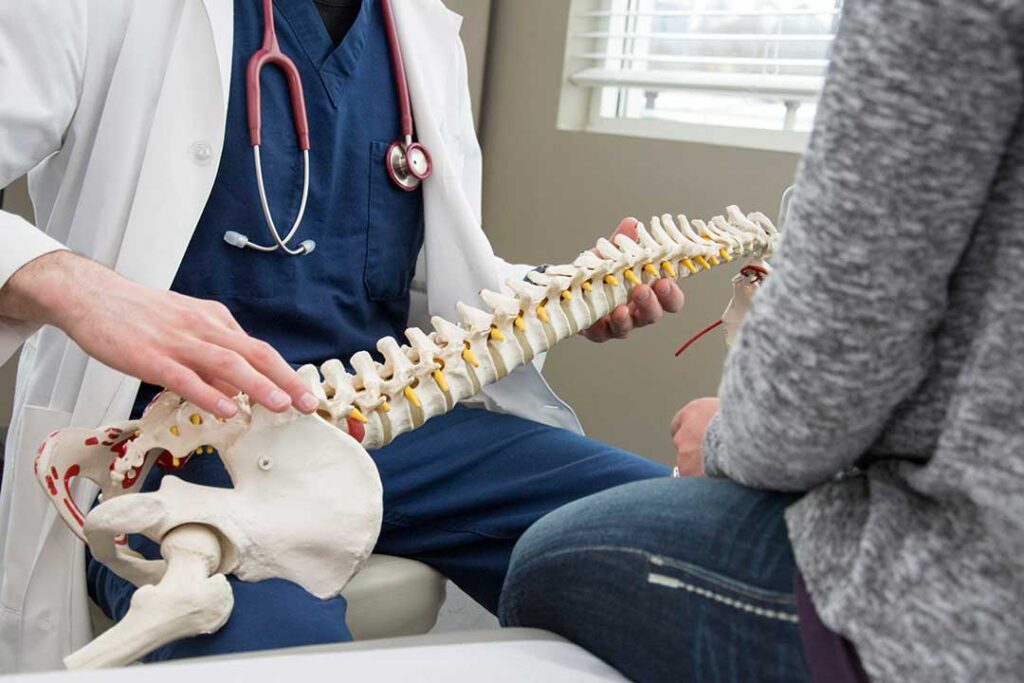
Spinal adjustments are controlled manual techniques intended to influence movement in or around spinal joints. They may reduce pain for some people, but their effects are usually modest and should be understood as one part of a broader approach to musculoskeletal health—not as a correction of every health problem.
What happens during a spinal adjustment?
A spinal adjustment, also called spinal manipulation, uses a carefully directed force applied to a joint in the spine. The force may be delivered by hand or with an instrument, and the movement is typically quick but controlled.
The technique is different from spinal mobilization. Mobilization uses slower, gentler movements within a joint’s available range, while manipulation usually involves a short thrust that moves the joint slightly farther than a person could comfortably move it on their own.
An adjustment may be performed with the person lying face down, on their side, or in another supported position. The goal is not to “put a bone back in place.” Spinal bones generally do not shift out of position during ordinary back or neck pain. Instead, the technique is used to influence joint motion, surrounding muscles, and the nervous system’s response to pain.
Why can an adjustment sometimes reduce pain?
The science suggests that pain relief may come from several overlapping effects rather than from one single mechanism.
A spinal adjustment can stimulate sensory receptors in the joints, muscles, and connective tissues. These signals travel through the nervous system and may temporarily change how the brain processes pain. This is sometimes described as altering pain sensitivity rather than mechanically removing a blockage.
The movement may also reduce protective muscle tightening. When an area hurts, nearby muscles can contract to limit motion. That response may be useful immediately after an injury, but prolonged guarding can contribute to stiffness and discomfort. A controlled movement may help a person move more normally, which can reduce the cycle of pain and tension.
Other possible effects include:
- A short-term increase in joint motion
- Changes in muscle activity
- Reduced sensitivity in nearby tissues
- Greater confidence with movement
- Improved ability to perform walking, lifting, sleeping, or household activities
The familiar popping sound is not proof that a joint has been “realigned.” It is usually associated with a rapid change in pressure within a joint, which can create a gas bubble. An adjustment can be effective without producing a sound, and a popping sound by itself does not demonstrate that treatment was needed.
What does research show for back pain?
For acute or chronic low-back pain, spinal manipulation may produce small improvements in pain and physical function. The average benefit is generally comparable to that of several other recommended non-drug approaches, including exercise-based care.
This does not mean every person will improve, or that manipulation is superior to other treatments. Research results vary because studies use different techniques, treatment schedules, comparison groups, and patient populations.
The strongest practical interpretation is that spinal manipulation may be a reasonable option for selected adults with uncomplicated low-back pain, especially when combined with education, normal activity, strengthening, mobility work, or other appropriate care.
For persistent pain, the broader plan often matters more than the adjustment itself. Sleep, stress, work demands, physical conditioning, previous injuries, and fear of movement can all influence recovery.
Can adjustments help neck pain or headaches?
Some studies suggest that spinal manipulation or mobilization may help certain people with persistent neck pain. It may also help some headaches that originate from the neck, sometimes called cervicogenic headaches.
That evidence should not be generalized to every headache. A headache may result from migraine, infection, medication effects, high blood pressure, vision problems, or other medical causes. A new, severe, rapidly worsening, or unusual headache should be medically evaluated rather than treated as a simple neck problem.
Neck manipulation deserves particular caution. Serious complications are rare, but sudden neck movements have been associated with cervical artery dissection, a tear in the wall of an artery that can lead to stroke. Research has not established in every case whether manipulation caused the condition or whether an underlying artery problem was already developing. People should be informed about the possibility and should report unusual symptoms immediately.
Warning signs after neck pain or manipulation include sudden severe headache, dizziness, fainting, double vision, trouble speaking, weakness, numbness, loss of balance, or difficulty swallowing. These symptoms require urgent medical attention.
Is soreness after an adjustment normal?
Mild temporary soreness, stiffness, increased pain, or headache can occur after spinal manipulation. These effects often improve within a day or two.
A brief reaction is not necessarily evidence that treatment “worked.” Likewise, feeling better immediately does not prove that the underlying cause has been permanently resolved. The more useful questions are whether movement and daily function improve over time and whether symptoms remain manageable between visits.
Severe, progressive, or persistent symptoms should not be dismissed as a normal treatment response.
Who should use extra caution?
A thorough health history matters before any spinal technique. Extra caution may be needed with:
- Recent significant trauma
- Suspected fracture or severe osteoporosis
- Known cancer affecting the spine
- Infection or fever with spinal pain
- Progressive weakness or loss of sensation
- Loss of bladder or bowel control
- Unexplained weight loss or severe nighttime pain
- Blood-clotting disorders or use of blood-thinning medication
- Inflammatory conditions affecting the spine
- Recent surgery
- Pregnancy or other health circumstances requiring modified positioning

Leg pain alone does not always mean manipulation is unsafe, but leg pain accompanied by progressive weakness, numbness in the groin area, or bladder or bowel changes requires prompt medical evaluation.
How does local life affect spinal pain?
Residents in Lynbrook may experience back and neck strain from ordinary routines rather than a single dramatic injury. Long periods in a car or at a desk, lifting children or household items, repetitive home maintenance, and limited movement during cold or rainy weather can all contribute to stiffness.
Seasonal habits can also matter. People may become less active during colder months, then place sudden demands on the back during spring cleaning, yard work, moving projects, or recreational activities. The risk is often related to the rapid change in workload, not simply to the activity itself.
Practical prevention includes gradual conditioning, changing position regularly, using safe lifting mechanics, and building strength in the hips, legs, trunk, and upper back. These measures can support recovery whether or not spinal manipulation is part of the plan.
What should a person expect from evidence-based care?
A careful evaluation should connect the technique to a specific symptom, functional goal, and safety assessment. Useful questions include:
- What condition is being addressed?
- What improvement should be expected, and over what timeframe?
- Are exercise, education, medication, physical therapy, or other options also appropriate?
- What symptoms would require medical evaluation?
- What is the plan if progress does not occur?
Spinal adjustments can be useful for some forms of back or neck pain, but they are not a universal solution and cannot treat every cause of spinal symptoms. The science supports a measured view: possible short-term improvement for selected problems, limited evidence for broad health claims, and a need for individualized screening and informed decision-making.
