
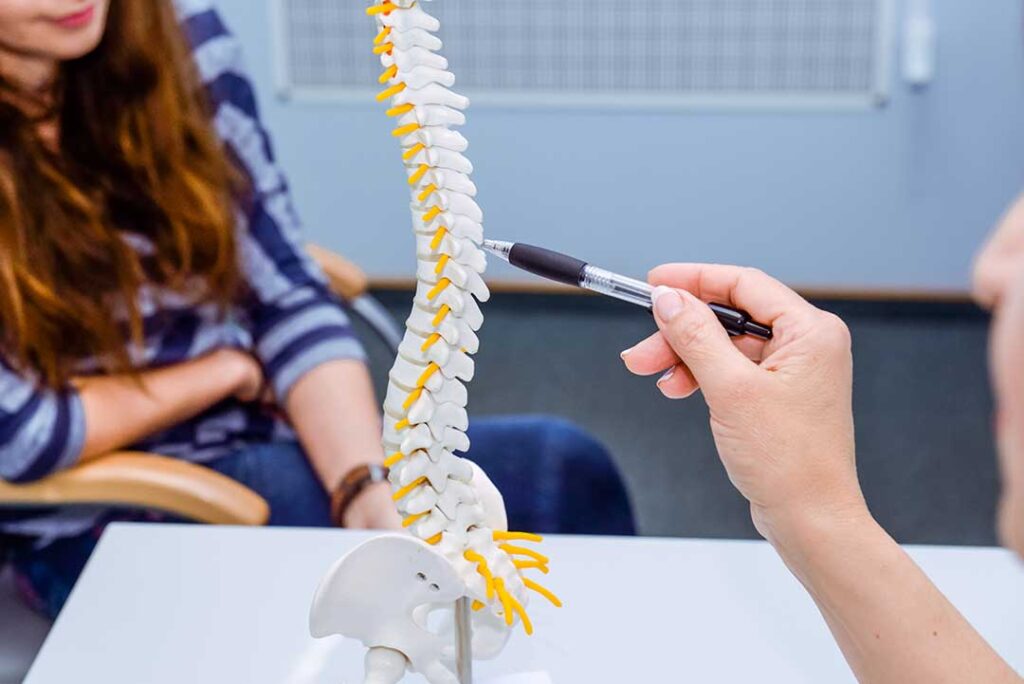
A herniated disc can cause anything from localized back or neck pain to sharp, traveling pain, numbness, tingling, or weakness in an arm or leg. Although the condition can be frightening, many people improve with conservative care and time. Chiropractic care may be part of that approach for selected patients, but it should begin with a careful examination and awareness of warning signs.
What is a herniated disc?
A herniated disc occurs when the soft inner material of a spinal disc pushes through a weakened or torn area of its tougher outer layer. Spinal discs sit between the vertebrae and help absorb pressure during standing, walking, lifting, and other movements.
A disc may bulge without causing symptoms. Pain usually develops when the disc irritates nearby tissues or presses against a spinal nerve. In the lower back, this may produce sciatica—pain that travels through the buttock and down one leg. In the neck, a herniated disc may cause pain, tingling, or weakness extending into the shoulder, arm, or hand.
A herniated disc is not the only possible cause of back pain. Muscle strain, arthritis, spinal narrowing, sacroiliac joint problems, and other conditions can create similar symptoms.
What symptoms should residents watch for?
Symptoms depend on the location of the disc and the nerve involved. Common signs include:
- Sharp, burning, or electric-like pain in the back, neck, buttock, arm, or leg
- Numbness or tingling along part of an arm or leg
- Muscle weakness, such as difficulty lifting the foot, standing on the toes, gripping objects, or raising an arm
- Pain that worsens with coughing, sneezing, bending, prolonged sitting, or straining
- Reduced range of motion or muscle spasms
For example, someone who spends long hours at a desk, drives frequently, or works in a home that requires repeated stair use may notice symptoms during sitting, lifting laundry, carrying groceries, or moving outdoor equipment after a storm. These activities do not necessarily cause a herniation, but they can make nerve-related symptoms more noticeable.
Does a herniated disc always require an MRI?
No. Imaging is not automatically needed during the first days or weeks of uncomplicated back pain. A healthcare professional may first assess strength, reflexes, sensation, walking ability, and movements that reproduce symptoms.
An MRI may be considered when symptoms persist, severe nerve pain does not improve, weakness is progressing, or an injection or surgery is being considered. An X-ray can show bones and alignment but cannot confirm a herniated disc by itself.
MRI findings also need to be interpreted carefully. Disc bulges and other age-related changes are common in people who have no pain. The scan should be considered alongside the physical examination and symptom pattern rather than treated as the diagnosis by itself.
How can chiropractic care fit into treatment?
Chiropractic care may focus on reducing pain, improving movement, and helping a person return gradually to normal activity. Depending on the examination, care may include gentle spinal mobilization, selected forms of manipulation, soft-tissue techniques, movement education, and exercises.
The word “adjustment” does not mean a disc is being pushed back into place. Chiropractic treatment cannot physically reverse every disc change, and there is no reliable method that guarantees a herniated disc will be “put back” permanently. The practical goal is usually to reduce irritation, improve function, and support recovery while the body heals.
Spinal manipulation has been studied as one option for low-back pain and may provide mild to moderate relief for some people. Evidence does not show that it is appropriate for every disc herniation. A treatment plan should be modified or avoided when the examination suggests significant nerve damage, fracture, infection, cancer, severe inflammation, or another condition outside routine musculoskeletal care.
Neck symptoms require particular caution. High-velocity neck manipulation is not appropriate for everyone, especially people with certain vascular, bone, neurological, or connective-tissue conditions. Patients should share their complete medical history, medications, recent injuries, and any prior imaging before treatment.
What other conservative measures may help?
Most uncomplicated disc-related symptoms are initially managed without surgery. The specific plan depends on age, health history, symptom severity, and neurological findings. Common components may include:
- Maintaining light daily movement instead of prolonged bed rest
- Temporarily reducing heavy lifting, deep bending, and repeated twisting
- Using heat or cold according to which feels more comfortable
- Following a gradual exercise or physical therapy program
- Improving lifting mechanics and changing positions regularly
- Using medication only as directed and after checking for safety with a qualified healthcare provider

Short walks may be more useful than staying in bed for several days. During recovery, it may help to divide household tasks into smaller steps, keep commonly used items within easy reach, and avoid lifting while twisting. Cold, icy conditions can also increase the chance of a sudden slip or awkward movement, so careful footwear and cleared walkways are sensible during winter weather.
Improvement often occurs over several weeks, although numbness or weakness may take longer to resolve. Persistent or worsening symptoms deserve reassessment rather than repeated self-treatment.
When is a herniated disc an emergency?
Certain symptoms require immediate medical evaluation because they may indicate serious compression of the nerves in the lower spinal canal:
- New loss of bladder control or inability to urinate
- Loss of bowel control
- Numbness in the groin, inner thighs, buttocks, or “saddle” region
- Rapidly worsening weakness in one or both legs
- Severe symptoms affecting both legs
- Back pain accompanied by fever, unexplained weight loss, major trauma, or a history of cancer
These warning signs are uncommon, but they should not be managed with routine chiropractic care alone. Urgent evaluation is especially important when weakness is progressing or bladder and bowel changes appear.
Can chiropractic care replace surgery?
Usually, the question is not whether chiropractic care “replaces” surgery but whether a person has signs that make conservative treatment reasonable. Many people with disc herniation improve without an operation. Surgery may be considered when there is severe or progressive weakness, emergency nerve compression, or pain and functional limitation that remain substantial despite an appropriate period of nonsurgical care.
A coordinated approach may involve a primary care clinician, physical therapist, pain specialist, neurologist, orthopedic clinician, or spine surgeon, depending on the situation. Chiropractic care can be considered within that broader plan when the examination supports it.
For residents of Lynbrook, NY, the most useful first step is to distinguish ordinary mechanical pain from symptoms involving nerve function. Pain alone may improve with time and conservative measures, but new weakness, spreading numbness, or changes in bladder or bowel function should take priority over routine back-care strategies.
