

Golf places repeated demands on the hips, spine, shoulders, wrists, and knees. A chiropractic approach may help some golfers move more comfortably by addressing joint motion, muscle balance, and the physical habits that influence the swing. It is not a substitute for golf instruction, strength training, medical evaluation, or treatment of a serious injury.
For residents of Lynbrook, NY, seasonal golf often means shifting from relatively inactive winter months into a spring and summer routine that includes practice sessions, walking, carrying equipment, and playing several rounds close together. That sudden increase in activity can expose mobility and strength limitations that were less noticeable during the off-season.
How can chiropractic care affect a golf swing?
Chiropractic care may support golf performance by improving the way the body moves before, during, and after the swing. The main potential benefits involve mobility, coordination, comfort, and awareness of movement limitations.
A golf swing requires the hips and upper back to rotate while the lower back provides stability. If the hips or upper back do not move well, the lower back may rotate or extend more than necessary. This can increase strain, particularly during repeated swings or when a golfer tries to generate more clubhead speed.
Depending on the individual, care may include:
- Joint mobilization or manipulation
- Soft-tissue techniques
- Mobility exercises
- Core and hip strengthening
- Guidance on warm-up and recovery habits
- Advice about gradually increasing practice volume
The goal should be functional movement rather than simply making a joint “crack.” A useful evaluation considers how the spine, pelvis, hips, shoulders, and legs work together.
Can chiropractic care help with golf-related back pain?
It may help some people with uncomplicated mechanical low back pain, especially when treatment is combined with exercise and changes in activity. Research on golfers consistently identifies the lower back as a common site of discomfort, but the causes are not identical for every player.
Back pain may be influenced by:
- Limited hip rotation
- Stiffness in the upper back
- Weakness or poor endurance in the trunk and hips
- Repeated practice without adequate recovery
- A sudden return to golf after inactivity
- Poor warm-up habits
- Swing mechanics that place excessive stress on the lumbar spine
- Carrying or lifting equipment awkwardly
Spinal manipulation can provide modest relief for some types of low back pain, but it is not universally appropriate and does not correct every source of pain. Exercise, movement retraining, physical therapy, rest from aggravating activity, and medical care may also be useful, depending on the problem.
A golfer should not assume that pain is simply a normal part of playing. Pain that is severe, persistent, worsening, or associated with numbness, weakness, fever, unexplained weight loss, or changes in bladder or bowel control requires prompt medical evaluation.
Why do hips and the upper back matter so much?
The hips and upper back help distribute rotational forces during the backswing and follow-through. When either area is restricted, the golfer may compensate through the lower back, knees, shoulders, or elbows.
For example, a golfer with limited hip rotation may lift the heel excessively, sway away from the target, or rotate the pelvis unevenly. A golfer with limited upper-back motion may turn the lower spine more aggressively to complete the backswing. These compensations can affect both comfort and consistency.
A movement assessment may examine:
- Hip rotation on both sides
- Ability to bend and extend without pain
- Upper-back rotation
- Shoulder range of motion
- Balance during a single-leg stance
- Trunk control during a squat or hinge
- Whether symptoms appear during practice swings or only after play
Improved mobility does not automatically produce a better score. However, reducing unnecessary restrictions can make it easier to repeat a comfortable swing and follow a sensible training plan.
What exercises are useful for golfers?
Golfers generally benefit from exercises that improve trunk endurance, hip strength, balance, and controlled rotation. The right program depends on age, fitness, injury history, and current symptoms.
Common examples include:
- Hip bridges for the gluteal muscles
- Side-lying leg raises for hip stability
- Bird-dog exercises for trunk control
- Planks performed with proper form
- Thoracic rotation movements
- Hip-flexor and hamstring mobility work
- Split-stance balance exercises
- Controlled medicine-ball or resistance-band rotations when appropriate
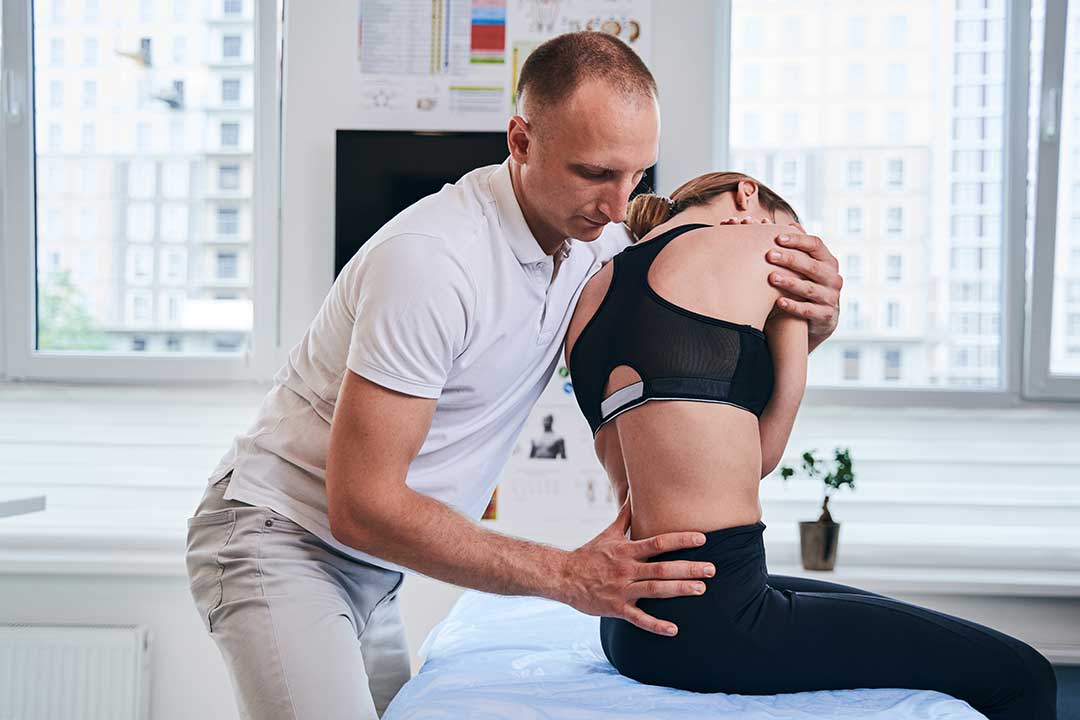
Exercises should be performed without sharp pain, radiating symptoms, or loss of control. More is not always better. A golfer who performs demanding rotational exercises immediately before a long round may create fatigue rather than improve performance.
A practical weekly routine often includes mobility work several times per week, strength training on nonconsecutive days, and a gradual increase in swings and playing time.
Does chiropractic care improve distance or accuracy?
There is no reliable basis for promising that spinal adjustments alone will increase driving distance, lower scores, or correct a slice. Golf performance depends on technique, equipment, physical conditioning, practice quality, sleep, concentration, and course conditions.
Chiropractic care may indirectly support performance when discomfort or restricted movement prevents a golfer from practicing normally. A player who can rotate, hinge, walk, and recover more comfortably may be better able to work with a golf instructor and follow a conditioning program.
The most realistic expectation is improved physical readiness, not a guaranteed change in skill.
How should a golfer prepare for a round?
A brief warm-up is more useful than starting with full-power swings. Before playing, a golfer can begin with several minutes of walking followed by controlled movements for the hips, shoulders, and upper back. Practice swings should progress from short and easy to longer and faster.
Helpful habits include:
- Start with putting or short chips before full swings.
- Avoid hitting a large bucket of balls at maximum effort.
- Take short breaks during practice.
- Increase weekly playing volume gradually.
- Use a push cart when carrying equipment aggravates symptoms.
- Replace worn footwear if balance or traction is affected.
- Pay attention to cold, damp, or windy conditions that may increase stiffness.
- Cool down with easy walking and gentle mobility rather than aggressive stretching.
In a dense suburban community such as Lynbrook, many golfers may fit practice or rounds around work, family responsibilities, and limited daylight. That makes consistency more practical than occasional, high-volume sessions that leave the body sore for several days.
When should a golfer seek further evaluation?
A chiropractor, physician, physical therapist, or sports medicine clinician may be appropriate depending on the symptoms and the suspected cause. Evaluation is especially important when pain follows a fall, sudden twisting injury, or direct impact.
Further assessment is also warranted when symptoms:
- Persist despite reducing activity
- Travel into an arm or leg
- Cause numbness, tingling, or weakness
- Wake a person repeatedly at night
- Prevent normal walking or daily activities
- Return every time the golfer resumes a swing
- Are accompanied by significant swelling or loss of motion
Chiropractic care can be one part of a broader plan for golfers. The most useful approach combines an individualized examination, gradual conditioning, sound swing instruction, adequate recovery, and attention to warning signs that require medical care.
